Starbucks Inventory Management Changes: Why the AI Transition Failed
Starbucks made significant updates to its inventory management system between 2025 and 2026, shifting away from a highly automated AI-based counting tool toward a more standardized inventory control process.
The change reflects the company’s ongoing effort to improve product availability, reduce stock discrepancies, and strengthen supply chain reliability across its global store network.
From Manual Counting to AI-Powered Inventory Tracking
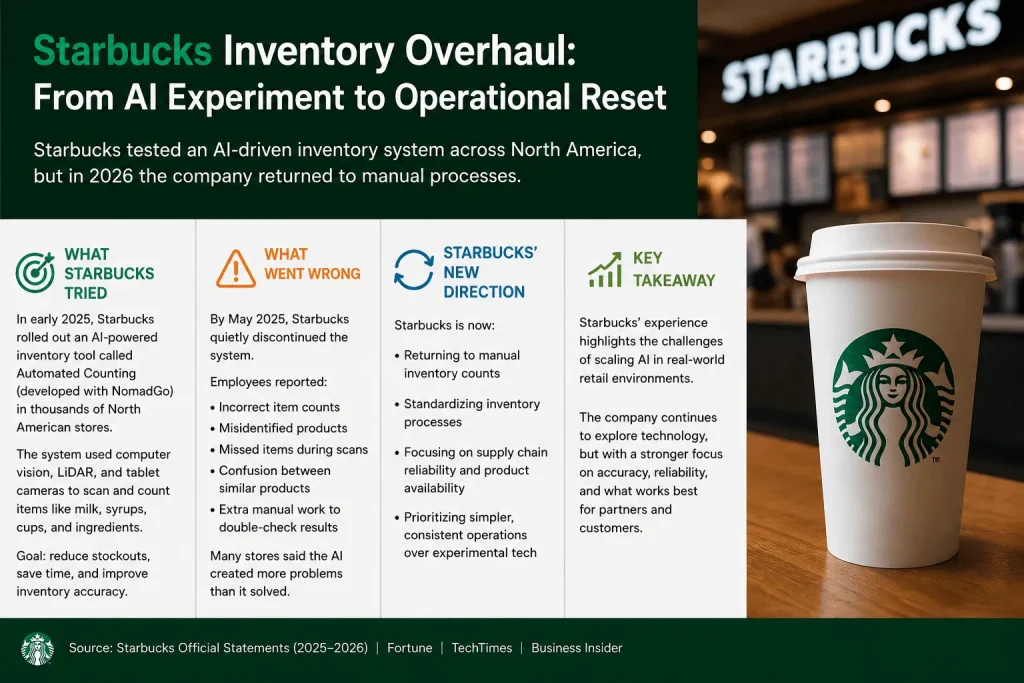
In 2025, Starbucks introduced an AI-driven inventory system called Automated Counting, developed in collaboration with NomadGo.
The system was designed to modernize in-store stock tracking using advanced technologies, including:
- Tablet-based scanning tools
- Computer vision for product recognition
- LiDAR (3D spatial mapping)
- Augmented reality overlays for shelf tracking
Main Objectives of the System
The AI inventory tool aimed to:
- Speed up store-level inventory counts
- Reduce manual counting workload for employees
- Improve visibility of key items like milk, syrups, and toppings
- Enable more accurate automated reordering in the long term
According to Starbucks’ internal goals, the system was expected to increase inventory counting frequency by up to 8×, helping reduce stockouts and improve product availability.
Operational Challenges and System Accuracy Issues
Despite strong expectations, the AI-powered inventory system quickly faced real-world challenges once deployed in busy store environments.
Key Issues Reported:
- Inaccurate stock counts in live store conditions
- Confusion between similar product types (e.g., milk variants, syrup flavors)
- Missed or misidentified shelf items
- Errors caused by inconsistent or cluttered store layouts
- Additional workload for staff correcting system-generated data
In practice, these issues reduced operational efficiency in many locations, particularly high-volume stores where inventory turnover is faster.
Employees also reported that the system sometimes increased backroom workload instead of reducing it, limiting the intended productivity gains.
Discontinuation of the AI Inventory Tool (2026)
By May 2026, Starbucks had discontinued the AI-based inventory system across North America after approximately nine months of usage.
The company transitioned back to a more standardized inventory management approach focused on:
- Improved accuracy in stock reporting
- Reduced operational errors in supply planning
- More consistent store-level workflows
This decision followed internal performance reviews and employee feedback highlighting ongoing inconsistencies between AI-generated data and real-world inventory conditions.
Why Starbucks Changed Its Inventory Strategy
The shift does not represent a rejection of technology, but rather a refinement of how it is applied in store operations.
Key Reasons Behind the Change:
- Need for higher accuracy in real-world store environments
- Reducing complexity for frontline staff (baristas and store teams)
- Improving product availability and reducing stockouts
- Preventing AI-driven miscounts from impacting customer experience
- Strengthening supply chain forecasting reliability
Starbucks Supply Chain and Operations Strategy Going Forward
Starbucks is now focusing on a hybrid operational model that combines technology with human verification rather than full automation.
The updated approach includes:
- Human-verified inventory checks
- Improved demand forecasting tools
- Simplified store-level inventory workflows
Bigger Picture: Ongoing Supply Chain Modernization
The inventory system change is part of a larger operational transformation that also includes:
- Store operational restructuring
- Menu simplification initiatives
- Digital tools for staffing and order management
- Broader supply chain optimization programs
However, industry reports suggest Starbucks continues to face challenges such as supply variability, fragmented supplier networks, and forecasting limitations—making inventory management a continuing strategic priority.
Quick Starbucks Tip : Planning your next coffee run? Avoid the hassle at the register and Check Starbucks Gift Card Balance ahead of time so you know exactly what you have left for your favorite brew!
FAQs
What are Starbucks inventory management changes in 2025–2026?
Starbucks updated its inventory system by shifting away from a fully AI-powered counting tool and moving toward a more reliable hybrid system that combines human checks with digital tools to improve accuracy and store operations.
Why did Starbucks change its inventory system?
Starbucks changed its system because the AI inventory tool showed accuracy issues in real store environments, including miscounts and inconsistent performance across different store layouts.
What was Starbucks AI inventory system used for?
It was designed to automate stock counting using technologies like computer vision and LiDAR to track ingredients such as milk, syrups, coffee beans, and food items more efficiently.
Is Starbucks still using AI for inventory management?
Yes, but in a limited way. Starbucks now uses a hybrid approach where AI supports inventory tracking, but human verification is still required for accuracy.
What problems did Starbucks face with AI inventory?
The main problems included incorrect stock counts, difficulty recognizing similar products, inconsistent results across stores, and increased workload for employees correcting errors.